About Cargill in Nicaragua
Cargill has been operating in Nicaragua since the year 2000 at Masaya. This processing plant is for human nutrition, specifically a chicken processing plant.
2000
Operating Since
Masaya
Nicaragua
2
Vulcan Units
Parent Company: Cargill de Nicaragua S.A., Managua, Nicaragua
Facility: Human nutrition chicken processing plant
The Challenge
Limescale in the cooling tubes, due to minerals present in the water and heat exchange, was reducing the capacity of the evaporative condensers and decreasing performance. Despite water softening (targeting 60 ppm) and chemical treatment with three chemicals (antiscaling, antioxidant, and algaecide), good results were not obtained.
The Solution: Two Vulcan Units for Complete Protection
Refrigeration Refill Line
Model: Vulcan S25
Pipe: 2-inch steel pipe
Water Capacity: 20 m³/h (88 GPM)
Location: Refilling line of the refrigeration area
Condenser Closed Circuit
Model: Vulcan S100
Pipe: 6-inch PVC pipe (DN150)
Water Capacity: 40 m³/h (176 GPM)
Location: Closed circuit of the condenser in the refrigeration area
Vulcan Models Used
This food processing plant installed two Vulcan models:
Installation
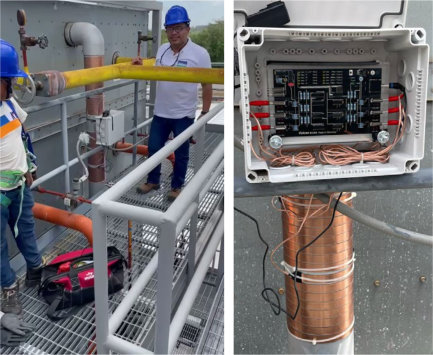
Vulcan S100 Installation
Installed on a 6" (DN150) PVC pipe at the closed circuit of the condenser.
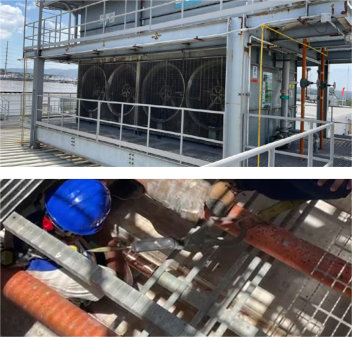
Cargill Plant
Human nutrition chicken processing plant in Masaya, Nicaragua.
3-Month Test Results
The Test Method
Four witness points were selected (portions of about 15 cm of pipe). The limescale was removed mechanically to verify if there would be re-incrustation with Vulcan during the test period.
Results After 3 Months
Result 1
The witness pipes remain free of new limescale.
Result 2
The areas around the witness pipes show that the limescale is more fragile, proving that VULCAN is removing the old limescale, cleaning little by little.
Result 3
Old layers of limescale are coming off. The formation of new limescale has stopped.
Visual Results
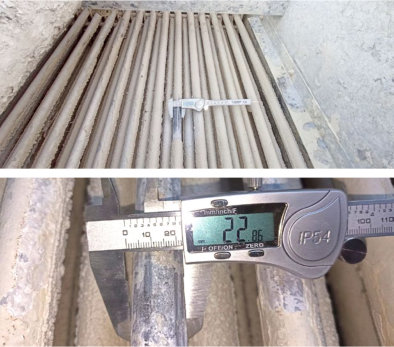
Before Vulcan
The Problem: Limescale in the cooling tubes, due to the minerals present in the water and the heat exchange. This happens in all the evaporative condensers in this area. Limescale reduces the capacity of the condenser, reducing its performance.
Previous Treatment: Water softening equipment in the engine room treats well water to reach 60 ppm hardness. Then in the condensers, three chemicals are added: antiscaling, antioxidant, and algaecide. Good results were not obtained despite these two treatments.
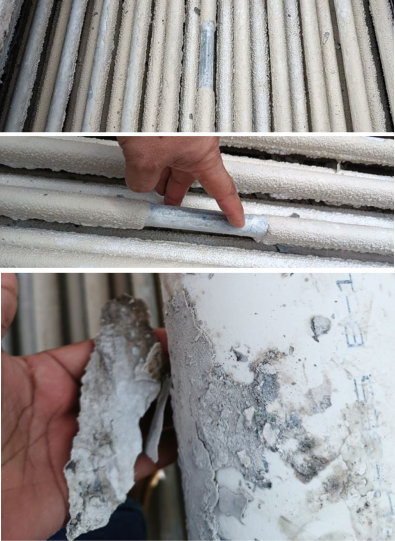
After 3 Months with Vulcan
Test Results: Four witness points (15 cm pipe sections) had scale removed mechanically to check for re-incrustation. After 3 months:
- The witness pipes remain free of new limescale.
- The areas around the witness pipes show that the limescale is more fragile, proving Vulcan is removing old scale little by little.
- Old layers of limescale are coming off.
The Challenge with Existing Treatment
Before Vulcan, the plant was using:
Water Softening
Water from the well was treated to reach 60 ppm hardness (expected).
Chemical Treatment
Three chemicals were added to the softened water: Antiscaling, antioxidant, and algaecide.
The Result
Good results were not obtained despite both treatments. Scale continued to form, reducing condenser performance.
What Vulcan Achieved
Even with the existing softening and chemical treatment still in place, Vulcan prevented new scale formation and began removing old scale deposits within just 3 months.
Benefits for Food Processing Plants
Refrigeration Efficiency
Scale-free condensers maintain cooling capacity and performance.
Reduced Chemical Use
Potential to reduce or eliminate chemical antiscalants.
Less Downtime
Fewer cleaning cycles mean more production time.
Food Safety
No chemicals added to water lines means no risk of contamination.
Vulcan Models Technical Specifications
Vulcan S25
| Max Pipe Diameter: | 4 inches |
| Max Water Flow: | 130 GPM |
| Wattage: | 2.25 W |
| Dimensions: | 7.9" x 4.9" x 1.6" |
Vulcan S100
| Max Pipe Diameter: | 6 inches |
| Max Water Flow: | 530 GPM |
| Wattage: | 2.5 W |
| Dimensions: | 9.4" x 5.6" x 1.6" |
Pipe Materials (both models): All types (iron, copper, stainless steel, PVC, PEX)
Maintenance: Zero for all models
Key Takeaway
Cargill Nicaragua demonstrates that even with existing water softening and chemical treatment, Vulcan delivers results. Within 3 months, witness pipes remained scale-free and old deposits began breaking away—proof that Vulcan works where conventional treatments fall short.
Related Food Industry Case Studies
Transform Your Food Processing Plant
Join Cargill and other industry leaders in protecting critical systems with Vulcan.
About the Author
Waslix provides non-chemical, maintenance-free scale prevention using Vulcan technology. This case study documents Vulcan S25 and S100 installations at Cargill's chicken processing plant in Masaya, Nicaragua.