The Energy Code Just Got Stricter: NYC Adopts 2025 NYS Standards
On January 17, 2026, New York City officially enacted Local Law 2026/047, repealing the old energy code section and adopting the 2025 New York State Energy Conservation Construction Code with local amendments .
What changed?
The new code references 2025 NYS ASHRAE 90.1 and imposes stricter efficiency requirements for:
- Commercial HVAC systems
- Residential mechanical equipment
- Building envelope performance
- Lighting and power systems
Who is affected?
New construction and gut renovations must comply immediately. However, existing mechanical systems operating under the old code are grandfathered only if properly maintained.
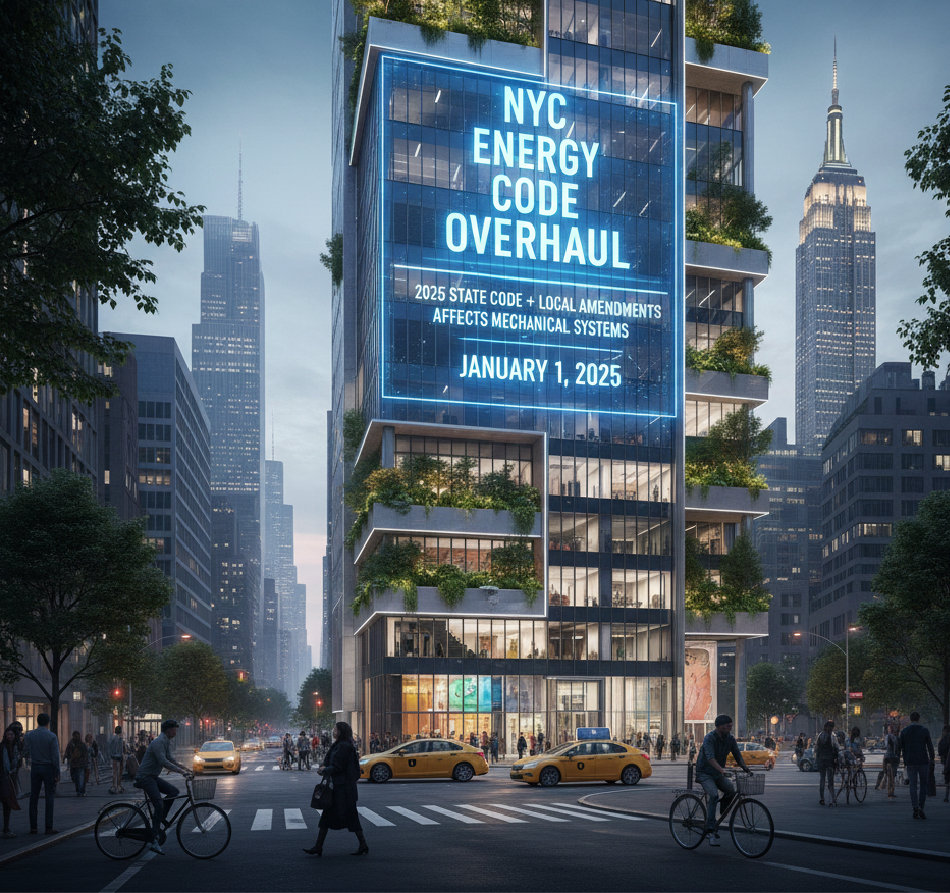
⚠️ The Grandfather Clause Trap
The NYC Administrative Code (§28-1001.2, ECC 101.2.1) states: "In the event of an addition to, or alteration of, an existing building... nothing in this code shall be interpreted to require any unaltered portion of such existing building or building system to comply with this code."
Translation: If you maintain it, you keep it. If you neglect it, you replace it. A fouled heat exchanger operating below code-minimum efficiency is NOT "properly maintained."
What "Properly Maintained" Actually Means
The new energy code does not require upgrades to existing systems—provided they are functioning at design efficiency.
But here is the problem most building owners miss:
Mineral scale is not "normal wear." It is a preventable degradation that reduces efficiency below legal minimums.
- 1/16″ scale = 12% efficiency loss
- 1/8″ scale = 25% efficiency loss
- 1/4″ scale = 40%+ efficiency loss
If your heat exchanger delta-T has dropped from 20°F to 12°F due to scale, you are no longer operating at code-minimum efficiency. Your equipment is no longer "grandfathered."
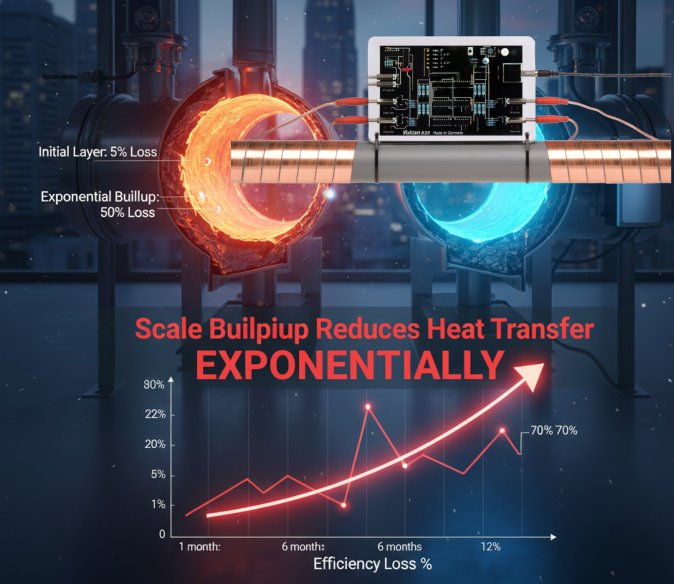
Scale buildup reduces heat transfer exponentially
✅ How Vulcan Protects Your Grandfathered Equipment
Restore Design Efficiency
Vulcan's impulse technology breaks existing scale and prevents new formation. Your heat exchanger returns to manufacturer-specified delta-T. You are back to "properly maintained" status.
Avoid Forced Replacement
If a DOB inspector or energy auditor finds a fouled heat exchanger, they can require replacement to meet current code. Vulcan eliminates that risk.
No Chemicals, No Maintenance
Chemical treatment requires ongoing verification and can fail if not replenished. Vulcan is passive—install once, protect forever.
Documentation Ready
Pre-installation efficiency measurements + post-installation improvement = proof that your equipment is "properly maintained" under the code.
Real Proof: The Aura Hotel, Budapest
The Problem: Brand new hotel. Six months after opening, every faucet was replaced. Ice machines failed monthly. Tiles required hours of manual cleaning.
The Cause: Mineral scale. Temperature + flow + time = precipitation, even in "soft" water systems.
The Vulcan Installation: One Vulcan S50 unit on the main water line. Zero maintenance. Three months later:
- "Faucets, tiles: clean with simple wipe."
- "Ice machine: working correctly."
- "Dishwasher: spotless, shiny glassware."
Head Chef Sándor Böröcz: "I really appreciate that all machines and equipment work properly again in the kitchen and I can focus on creating and serving the best meals to our guests."
 Aura Hotel, Budapest — Vulcan S50 installation
🍽️ Commercial Application: O2 Water Margin Restaurant
ROI in 90 days—on detergent alone.
After installing Vulcan S25:
- "Food warmers, steam ovens, kitchen sinks, restrooms: clear of scale."
- "Crockery and cutlery: cleaner, no rewashing."
- "Savings exceeded the cost of Vulcan S25."
- "Restaurant operating at higher level, far fewer customer complaints."
If a restaurant can achieve payback in 90 days, what is the payback for a commercial building facing a $500,000 boiler replacement?
🔍 The DOB Inspection Trap
Under the new energy code, DOB inspectors and energy auditors are trained to flag:
- High boiler stack temperatures (indicates scale insulation)
- Low heat exchanger delta-T (indicates fouling)
- Cold hot water return temperatures (indicates pipe scale)
If flagged, you face two choices:
❌ Option 1: Replace
Replace the boiler, heat exchanger, or entire system to meet current code. Cost: $50,000–$500,000+
✅ Option 2: Restore
Restore efficiency with Vulcan. Cost: $8,000–$25,000. Prove you are "properly maintained."
💰 The Cost Comparison
$500,000+
Full boiler replacement cost (commercial)
$50,000+
Heat exchanger replacement
$15,000
Average Vulcan installation (one-time)
When to Prioritize Vulcan Under the New Energy Code
- Immediate Priority: Any building with >25-year-old boilers or heat exchangers facing DOB inspection.
- High Priority: Buildings with measured delta-T below 80% of design specification.
- Mission Critical: Hospitals, data centers, universities where equipment failure = operational shutdown.
- Grandfather Protection: Any building relying on "properly maintained" status to avoid upgrades.
- Any Facility with: Heat exchangers, boilers, cooling towers, or recirculating hot water systems. If it transfers heat to water, it scales.
Protect Your Grandfathered Status Before the Next Inspection
The new energy code is law. DOB inspectors are trained. Don't let scale force a $500,000 replacement.
About the Author
Waslix- Clearly Clean Water (Vulcan Mineral Descaler) provides non-chemical, maintenance-free scale prevention solutions for commercial, industrial, and residential buildings. Vulcan is the only impulse technology with verified case studies across hotels, restaurants, and industrial facilities.