The "Blowdown" Efficiency Gap
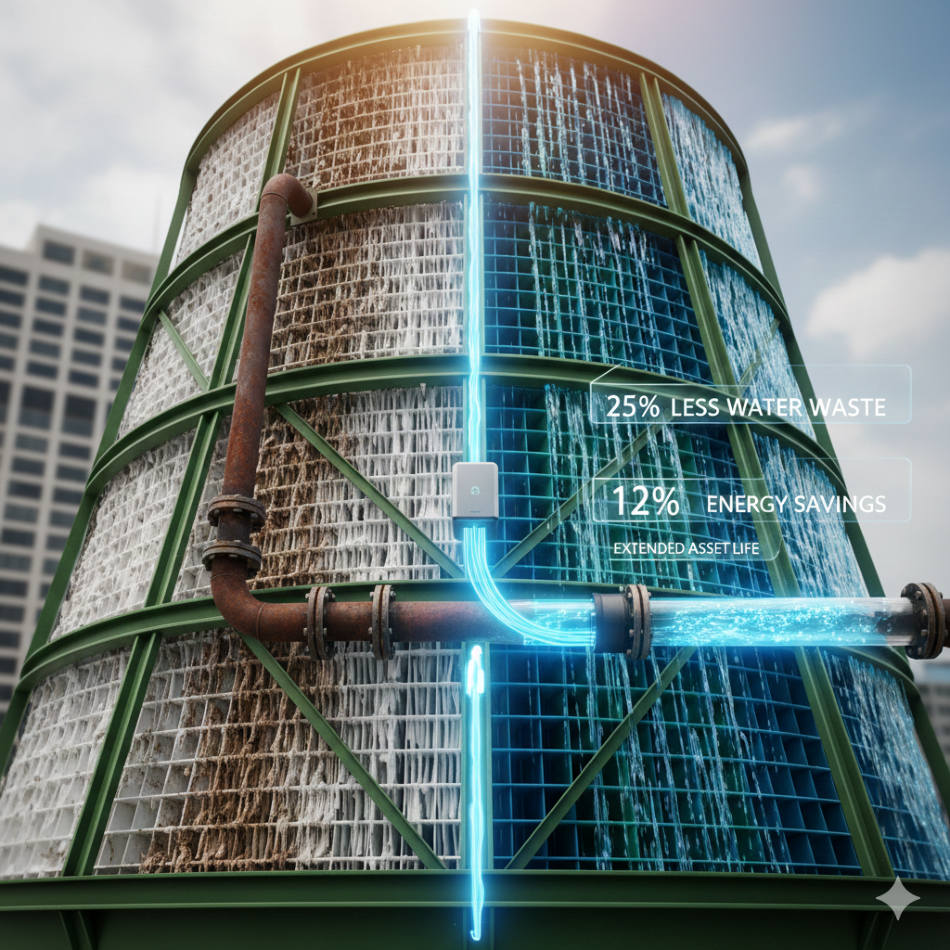
Cooling towers are the heart of commercial HVAC, but they are also the primary source of water waste. As water evaporates, mineral concentrations rise, leading to scale formation. To prevent this, systems trigger a "blowdown" cycle—draining mineral-heavy water and replacing it with fresh water. In scaled systems, these cycles happen too frequently, wasting 20% to 30% more water than necessary.
Thermal Resistance: The Energy Thief
Just 1mm of scale on heat exchanger tubes can increase energy consumption by 10% to 15%. Scale acts as a thermal insulator, forcing the chiller to run longer and harder to achieve the same cooling effect. This degradation of the heat transfer coefficient is the single largest driver of excessive OpEx in large-scale commercial real estate.
Increasing Cycles of Concentration (CoC)
Vulcan technology allows facilities to safely increase their Cycles of Concentration (CoC). By physically altering the crystallization of minerals, Vulcan prevents them from bonding to the tower fill and heat exchanger surfaces. This means you can keep water in the system longer, drastically reducing make-up water requirements and sewer discharge fees.
Ending the Chemical Dependency
Traditional cooling tower management relies on a cocktail of anti-scalants and biocides. Vulcan’s electronic impulse technology provides a non-chemical primary treatment, often allowing facilities to reduce chemical spend by 50% to 80%. This not only saves money but extends the life of the tower's galvanized or stainless steel components by reducing chemical corrosion.
The Bottom Line for Asset Managers
For a typical commercial high-rise, optimizing cooling tower efficiency with Vulcan can result in annual savings of $15,000 to $40,000 per tower in water, chemicals, and energy. When scaled across a REIT portfolio, the impact on asset valuation is measured in the millions.
- Portfolio Scalability: Vulcan units can be retrofitted to any cooling tower size without downtime or system bypasses.
- NOI Optimization: Significant reduction in water and sewer utility costs directly increases asset profitability.
- Asset Preservation: Protecting the chiller-bundle and tower fill prevents premature CAPEX replacement of the HVAC system.
- ESG Reporting: Directly contributes to GRESB and LEED points by reducing both water intensity and chemical discharge.